The signal is always there. You just have to build the filter.
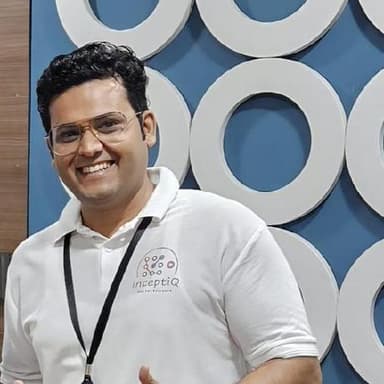
I'm Varun Pratap Bhardwaj — founder of Qualixar, Senior Manager & Solution Architect at Accenture, bar-licensed lawyer, and a daily student of Vedantic epistemology.
Founder · Engineer · Bar-Licensed · Vedanta Student
The problem that drives everything I build is deceptively simple: how do you know whether an AI agent is telling the truth? Not whether its output sounds plausible — whether the claim has a chain of custody you can inspect and challenge.
That question connects four threads in my life that look unrelated on a résumé — fifteen years of enterprise engineering, a law degree, a philosophy practice, and a research platform — but are, to my mind, the same inquiry running at different frequencies.
This page is an attempt to lay out those threads honestly, without collapsing them into each other or making the story neater than it is.
The threads that drive everything.
15+ years. 8 industries. 4 companies.
Started at Alcatel-Lucent building networking infrastructure for telecom carriers. Moved into software engineering at Tech Mahindra and HCL. Joined Accenture where I now lead enterprise-scale digital transformation for Fortune 500 European clients — teams of 100+, budgets in the tens of millions, delivery spanning aviation, energy, retail, banking, and chemicals. Won 5 consecutive Global Technology Innovation Awards (2021–2025) for building AI platforms for automated voice dubbing, sound effects generation, and video production. Recognized in national Indian media.
Nine instruments. Ten preprints. One platform.
In 2020, a question started nagging: why do AI agents behave so differently in production from how they behave in demos? I started building tools to answer it, and those tools turned into Qualixar — the AI Reliability Engineering platform. Today it has nine live open-source instruments (AgentAssert, SkillFortify, SuperLocalMemory, SLM Mesh, SLM MCP Hub, Qualixar OS, AgentAssay, Bounded Loops, Jev Decision Layer), ten published arXiv preprints, and six more instruments in active forge. Transitioning from independent research initiative to incorporated product company in 2026.
An argument either stands or it doesn't.
I hold a dual degree — B.Tech (Engineering) and LLB (Law) — and passed the All India Bar Examination (AIBE-passed). Law taught me something that engineering school didn't: every claim must survive adversarial scrutiny. There is no 'vibe-based' jurisprudence. I applied that discipline directly to AI verification. AgentAssert's behavioral contracts are written the way pleadings are written — with defined conditions, explicit scope, and enforceable failure modes.
The oldest reliability engineering framework I know.
For several years, I have spent my mornings with Sanskrit commentary — currently working through the Brihadaranyaka Upanishad with Shankara's Bhashya. I study Advaita Vedanta, Sāṅkhya Darśana, and Kashmir Shaivism. Not as religion. As epistemology. The Nyāya pramāṇas (valid means of knowledge) form the oldest verification API I've encountered. The Sāṅkhya tattvas read like a multi-agent architecture diagram. The Shaiva concepts of Prakāśa and Vimarśa map precisely to static weights and active runtime loops. I am writing a book — 'The Mirror and the Light' — exploring these correspondences without making either the science smaller or the philosophy larger than it is.
Three instruments, one tuning.
I make instruments that hold their pitch.
Nine shipped. Ten papers. One platform forged in the belief that AI agents deserve the same rigor we demand of bridges and brake pads. Fifteen years building enterprise systems that survive scaling.
Law was my first tuning fork.
The Bar teaches you that an argument either stands or falls — there is no 'vibe-based' jurisprudence. Passed the All India Bar Examination (AIBE-passed) to apply adversarial reasoning to technical system verification.
Vedanta is the original reliability engineering.
A method for testing the mind's outputs against an unchanging reference. Daily dawn study of Advaita Vedanta and Sāṅkhya epistemological validation (pramāṇa) which directly informs our verification work.
How I build.
- •Verify, don't claim. Every Qualixar instrument ships with formal contracts, stochastic test suites, or security proofs. An output without a chain of custody is not knowledge — it is noise.
- •Test the non-deterministic. AI agents do not behave the same way twice. Traditional test frameworks fail them. Building for stochasticity is the only honest approach.
- •Privacy is architecture. SuperLocalMemory runs entirely on-device. No cloud, no telemetry, no compromise. EU AI Act compliant by design, not by disclaimer.
- •Law is a tuning fork. Adversarial reasoning — the habit of an argument that must survive cross-examination — transfers directly to system verification. Passed the All India Bar Examination (AIBE-passed). Use it daily.
- •The ancients had a head start. Sāṅkhya's tattvas are a multi-agent architecture diagram. Nyāya's pramāṇas are a verification API. Reading them next to a contemporary agent paper, the structural overlap is not decorative — it cuts.
- •Open source or it didn't happen. Every research instrument is openly licensed. Ideas compound when shared. Walls around knowledge are a form of entropy.
What I'm looking for.
Research collaboration on agent reliability, verification, and epistemic systems. Speaking — conferences, universities, enterprise AI strategy briefings. Technical consulting on AI agent architecture. Career opportunities at organizations genuinely pushing the frontier of trustworthy AI. And conversations with people who think the ancient Indian epistemologists were building something useful.
Get in TouchAcademic Identifiers
Experience
Career & Expertise
Accenture
Senior Manager & Solution Architect
Leading digital transformation programs for Fortune 500 European enterprises. Managing 100+ member teams across multiple concurrent projects. End-to-end solutioning with GenAI and Agentic AI.
5× Global Technology Innovation Award Winner (2021–2025). Built AI platforms for automated voice dubbing, sound effects generation, and video production — recognized in national media.
Tech Mahindra
Software Engineer
Enterprise solution development for major US telecom and banking institutions.
HCL Technologies
Software Engineer
Digital platform development for global retail and telecom enterprises.
Alcatel-Lucent
Network Engineer
Where the journey began — building networking infrastructure for telecom carriers.
Technical Expertise
Tools & Technologies
Cloud & Infrastructure
Digital Experience
Commerce
Backend
Frontend
AI & ML
Architecture
Education
Dual Degree: B.Tech (Engineering) + LLB (Law)