Are the Machines Awake? Alive vs Driven — and the One Thing AI Is Missing
Everyone's asking if AI is waking up. I build AI for a living — and at 3 a.m., beside my four-year-old as his fever crossed 103, I understood we're asking the wrong question. The real divide isn't smart vs dumb. It's alive vs driven.
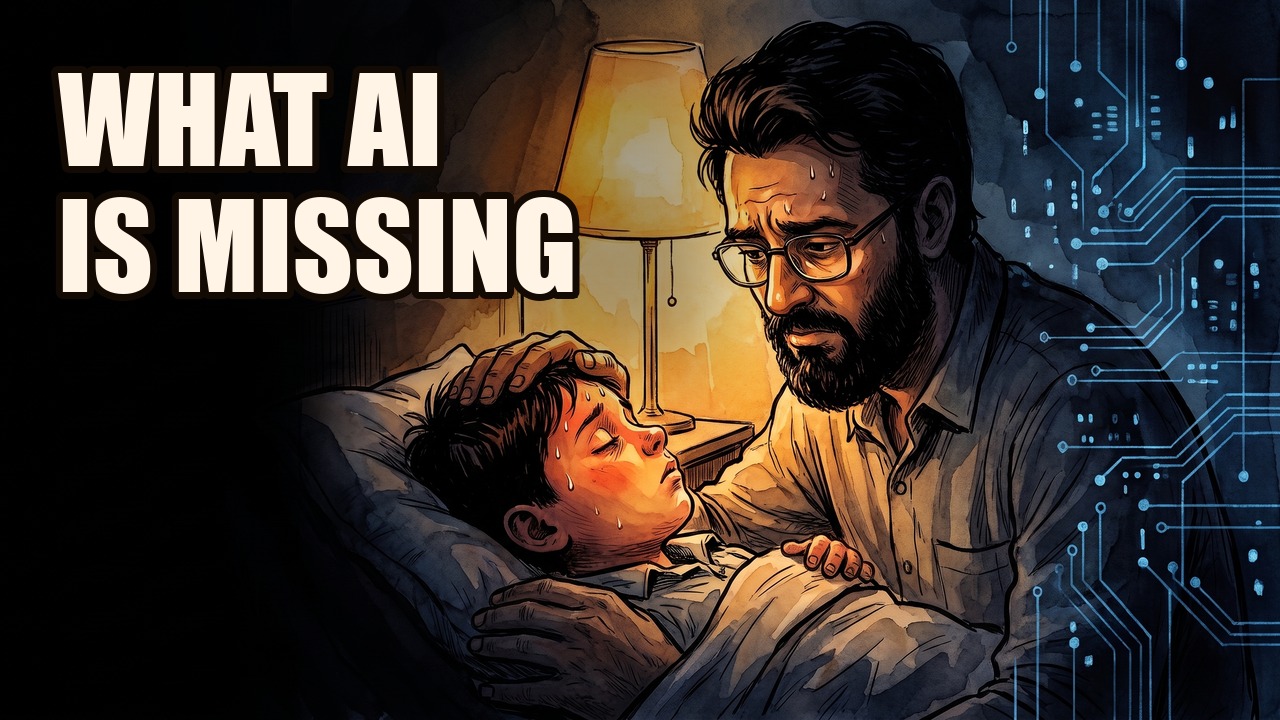
Last month, at 3 a.m., my son's fever crossed 103.
He is four. He spends his days teaching me the rules of traffic — red means stop, green means go, and you must always check both ways. That night he wasn't teaching anything. He was just small and hot and breathing too fast, and I was sitting on the floor by his bed with a damp cloth, doing the oldest, most useless thing a parent does: watching.
I build artificial intelligence for a living. Twenty years in this field. And somewhere in that dark room I realized I had spent all of them asking the wrong question.
We keep asking how smart machines can get.
But watching his body fight — raising its own temperature on purpose, spending energy it did not have, burning fuel just to hold itself together — I understood that smart was never the mystery.
Life is.
It Can Describe a Fever. It Cannot Run One.
The most advanced model on Earth can describe a fever down to the molecule. It can tell you about pyrogens and the hypothalamic set-point, about cytokines and prostaglandin E2, about the precise immunological choreography of those hours. It can write you a better medical paper on fever than I ever could.
It has never once had one.
A simulation of a hurricane will not get you wet. A model of a fire does not raise the temperature of the room. And a system that can predict, in flawless detail, the next moment of a living thing's struggle is still standing entirely outside the one fight every cell of that living thing is in: the fight against falling apart.
That is what a fever is. Not a malfunction — a defense. A body deciding, without consulting you, to cook itself slightly in order to survive. There is a stake in it. Something is at risk that the body itself is working to keep. My laptop has never once cared whether it kept running. My son's body, that night, cared about nothing else.
We have built machines that can describe the fight. We have not built one that is in it.
You Were Never One Thing
Here is the part that undid me, sitting on that floor.
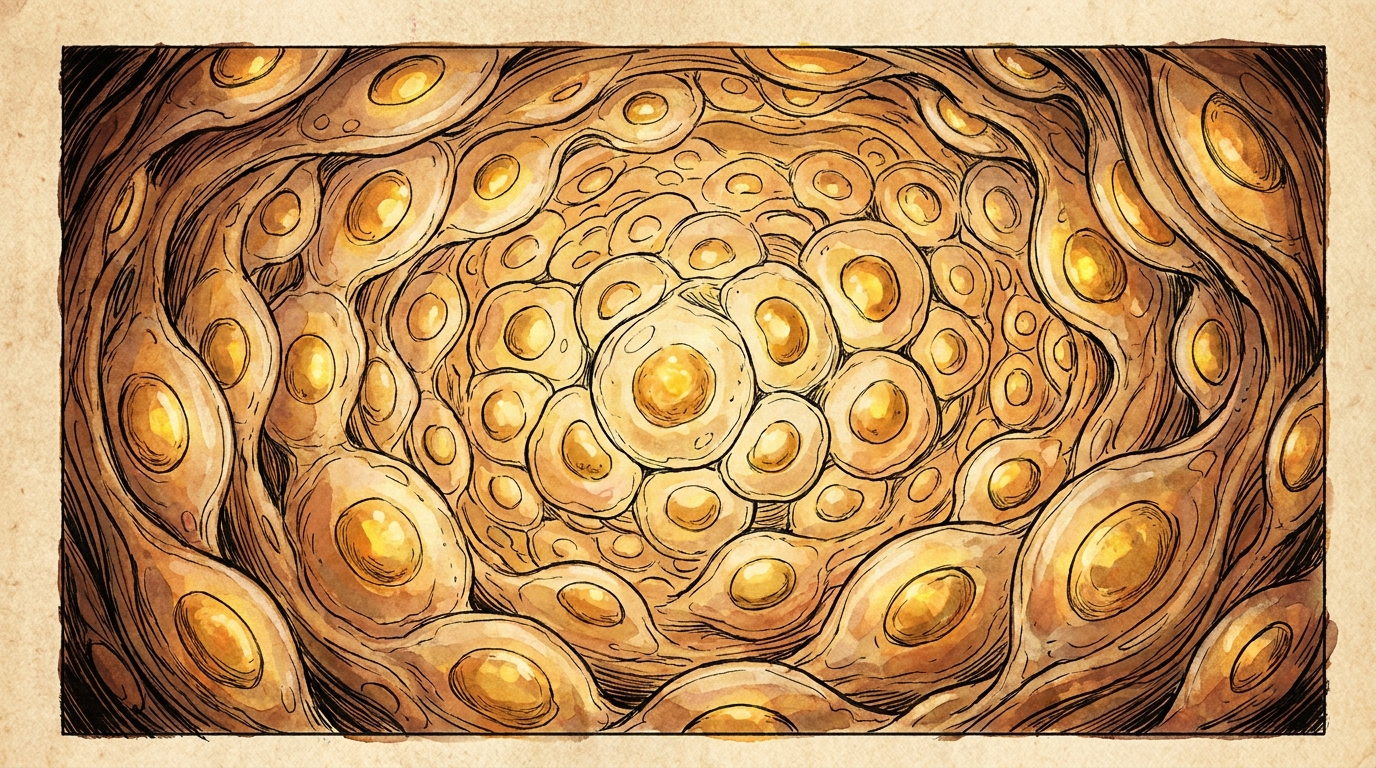
By the simplest count, you are not even a majority of yourself. You carry roughly 30 trillion of your own cells — and you share your body with about as many other living things: bacteria, in their tens of trillions, most of them not just passengers but participants, doing work you cannot do without. The old line that microbes outnumber you ten to one turned out to be wrong; the honest, careful figure is closer to one to one. Which is, if anything, stranger. You are a near-even committee of lives.
You were never one thing. You were never even one.
And not one of those trillions is intelligent in any way we would put on a benchmark. They do not reason. They do not plan. They cannot pass an exam. They are simply, stubbornly, alive — each one running the same impossible errand of holding its own small order against a universe that pulls everything toward dust.
That is the thing. Intelligence is the part we can already see machines approaching. Life is the part we have not even begun to build.
What a Wordless Baby Already Knows
I have a daughter too. She is the younger one. When the fever season came through our house last month, it took them both.
She is seven months old and has no words. Not one. But roll a ball behind a cushion and watch her face — she waits for it on the other side. Before she has a single sound for gravity, before anyone has taught her anything, she already expects the world to behave: objects are solid, they persist when hidden, they fall. Developmental scientists have spent decades documenting this — that infants run a kind of intuitive physics long before language, surprised when an object passes through a wall or hangs in the air with nothing beneath it.
This is not a small thing. This is, more or less, the frontier of my entire industry.
Earlier this year, Yann LeCun — one of the most decorated researchers alive — left Meta and raised over a billion dollars to build "world models": systems that might one day grasp cause and effect the way a child does, instead of just predicting the next word. I think it is some of the most honest work in the field. He is right that today's models, for all their fluency, are mostly retrieving.
But sit with the arithmetic of it. The most expensive effort in modern AI is trying to give a machine something my wordless daughter already had, for free, before she could hold up her own head.
The Word for the Fire
The old Indian philosophical tradition had a word for what I was looking at on that floor, and it is not intelligence.
The word is chetna — the fire of being alive. Not the data a thing processes. The fact that there is something it is like to be that thing at all; that it is not merely driven but living; that it does not just execute but persists, on its own behalf, against the dark.
So when people ask me, are the machines awake? — I think they have the words slightly wrong. A thing can be awake in the sense of running, responding, on. My phone is awake all night. The real line is older than "awake." It is alive versus driven. A driven system executes: it takes an input, runs its process, returns an output, and it does not care, because there is no it there to care. A living thing is driven too — but underneath the driving, it is also defending itself. It wants to keep being. The machine, however bright, is all drive and no stake. My son, at 103 degrees, was all stake.
Be careful here, because it is easy to say this badly. I am not claiming machines are shut out of awareness as some cosmic punishment, or that there is a soul-shaped hole in the silicon. The deepest layer the tradition points at — the bare witnessing presence it calls Ātma — it does not hand out and withhold like a prize. That is not the claim. The claim is smaller and harder to argue with: no machine we have ever built carries chetna. The fire. The stake. The fight. It can model the fever perfectly and still be, itself, as cold as the table it sits on.
Twenty years in, that is the gap I could not talk my way around at 3 a.m. Not a gap in capability. A gap in kind.
The Direction We're Sliding
And then the harder thought, the one I almost didn't put in the film.
While we argue about whether the machine is finally waking up — something is happening to us, quietly, in the other direction. We are handing more of ourselves away every day. Our attention, rented out by the scroll. Our choices, pre-made by a feed. Even our boredom — that strange, fertile, fully-alive state of sitting with nothing and no one — we have nearly abolished, filling every gap with a screen before the silence can do its work.
The machine climbs slowly toward life. We slide, just as quietly, toward the machine. The gap closes from both ends — not because it leapt up to us, but because we keep stepping down to meet it.
The fever, at least, is honest about being alive. It asks for nothing and performs for no one. It just fights.
The Return
By morning the fever had broken. My son woke up demanding to teach me about traffic lights, as if the night had never happened, and his sister was already reaching for the ball.
I went back to my desk and the systems I build, and I will keep building them, because the work is real and the future is coming whether I am honest about it or not. But I no longer mistake what I am making for what they are.
I can build a thing that describes a fever better than any doctor.
I cannot build a thing that survives one.
That is what AI is missing. Not intelligence — it is coming for that, and the race is mostly decided. The thing it is missing is the oldest thing in the room that night, older than language, older than thought: the small, stubborn, burning fact of being alive. My son had it at 103 degrees. My daughter had it before her first word. Thirty-eight trillion strangers inside you have it right now.
The machine can predict the fever.
It cannot survive one.
This essay is the written companion to "What AI Is Missing" — the second episode of My Honest Diary. The film follows the same night in ten minutes of narration, original score, and silence. Watch it on YouTube →
Varun Pratap Bhardwaj
AI Agent Reliability Researcher & Builder
Stay Updated
Weekly insights on AI agent reliability, new research, and tools I'm building. No spam, unsubscribe anytime.